Integrated Resource for Deaf Learners

A team around the child

To effectively meet the needs of each deaf child all professionals involved; teachers of the deaf, specialist support assistants, mainstream teachers and professionals from external agencies work closely as a team informing and involving parents in every aspect of the child’s development throughout primary education.

​External agency professionals include: 

  • ​Speech and language therapists who visit Greystones Primary School at the start of the academic year to assess the speech and language needs of all the children and to advise Integrated Resource staff.  If needed they will then come into school to work with your child once a week, typically in six week blocks.  Our IR staff consolidate the work done with the children in timetabled Resource sessions.
  • ​​An Educational Psychologist who may visit school at the request of a Teacher of the Deaf (and with your consent) to assess your child. 
  • Staff from either Bradford or Nottingham Cochlear Implant Centres who visit school on a regular basis to assess the progress of children who have had cochlear implants.

FAQs about our Integrated Resource

The integrated resource for deaf learners at Greystones has 12 places. These pupils are spread across the school. Typically, we have one or two deaf children in each year group.

All of the pupils in our IR have EHCPs (Educational Health Care Plans) and their primary need is that they are deaf (categorised as a ‘physical need’ Sheffield Support Grid | Sheffield). They are allocated a place at our IR, following consultation by the local authority SEND team. The staff in the IR are all specialists, trained to support deaf children and led by the Sheffield Deaf & Vision Support Service.

However, all the teachers and learning support staff at Greystones also have a good degree of awareness and training to support any child with hearing loss. in addition to our 12 deaf pupil places, our school also supports a small number of non-IR pupils who have hearing loss, but who do not qualify for an EHCP or a place at the IR.

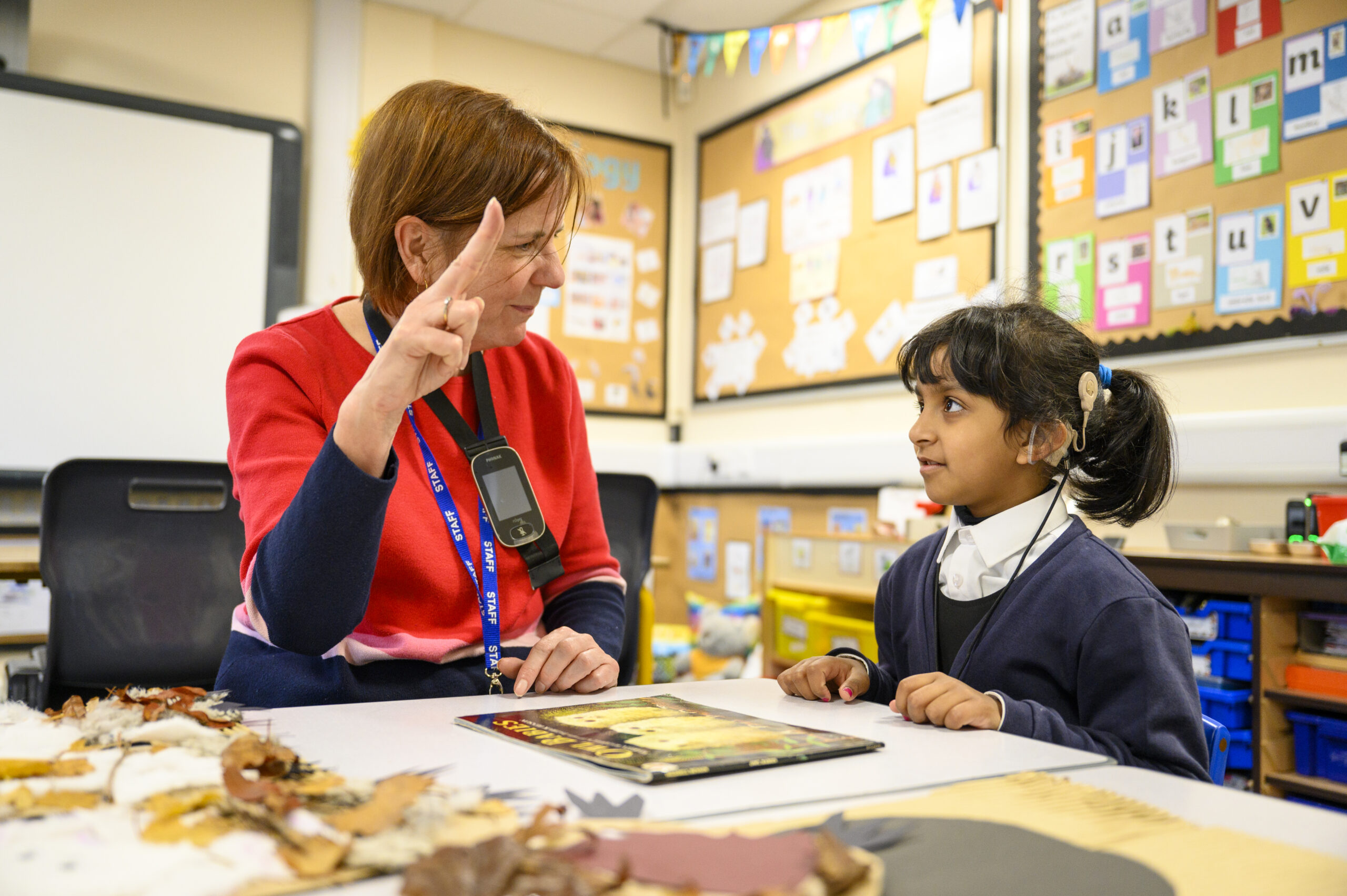
The children spend most of the school day with their own class.  Any extra help that is needed is provided by staff from the IR. The amount of time a hearing impaired child spends in the mainstream class and the level of support the child receives depends on the individual needs of the child.

Support can be given in a number of ways: 

  • Support in the mainstream class 
  • Individual support withdrawn to the IR 
  • Small group work with other hearing impaired children in the IR 
  • Small group work with their hearing and deaf peers in the IR – often referred to as ‘reverse integration’ 

The majority of support is given in the mainstream classroom.  IR time is spent: 

  • Reading books from the IR’s reading programme – Reading is given a high priority.  
  • Preparing for or consolidating class work, for example, working on vocabulary for a science lesson, support for class spellings or consolidation of a maths concept new to a child
  • Working on intervention programmes designed to promote the development of a child’s speech, language and communication skills
  • Developing listening skills
  • Targeting social and emotional literacy and developing the children’s own ‘Personal Understanding of Deafness’ in small groups 

We also run a range of clubs at lunchtimes to help the children support and develop friendships with their hearing and deaf peers, which include friendship club, art club, animation club and a signing choir. 

We also run a range of clubs at lunchtimes to help the children support and develop friendships with their hearing and deaf peers, which include friendship club, art club, animation club and a signing choir. 

Currently, we have two Teachers of the Deaf in the IR, as well as a number of Learning Support Staff (Teaching Assistants) who provide support for children in our IR base, as well as in their mainstream classrooms. Here is a link to our current staff team in the IR.

Audiology

Checks of hearing aids, ear moulds, cochlear implant systems, radio aids and sound field systems are carried out daily.

​To make sure all audiological equipment is working as it should we carry out various checks every morning when the children arrive at school.  

Audiological Targets

We encourage the children to value their hearing aids, increasingly manage (as appropriate) their own aids and understand their hearing loss.
To motivate children to independently manage their hearing aids we set audiological targets for each child. 

Back-up support

An audiologist from the Centre for Hearing and Speech at the Sheffield Children’s Hospital makes monthly visits to our IR.  The children’s ears, hearing aids and ear moulds are checked.  Ear mould impressions are taken when needed.  This reduces the number of clinic appointments at the hospital and hence the time your child takes out of school.  The Educational Audiologist visits fortnightly.

We are in close contact with the cochlear implant centres should a fault arise with a cochlear implant processor.

Radio Hearing Aids and Sound Field Systems

For a hearing impaired child the effects of the varying distance from the teacher, poor acoustics and the background noise in a classroom combine to make speech difficult to understand. 

To alleviate these problems we provide each child with a radio hearing aid (typically from their first or second year at school).  These are used in conjunction with a sound field system.  ​

The teacher wears a radio aid transmitter which allows the teacher’s voice to be sent as a radio signal to the radio aid receiver that the child wears. In this way, no matter where the child is sitting or the teacher stands in the classroom the teacher’s voice will have the same clarity. All classrooms with deaf learners also have a soundfield system, which is speaker located at the front of the classroom,  which means speech can be heard evenly across the different areas of the classroom. As well as a microphone for the teacher, there is a microphone for the children to pass around. This ensures children are able to hear others across the room and also promotes good turn taking skills in class discussions. 

The radio aid receiver used by children with hearing aids is integrated into their hearing aids.

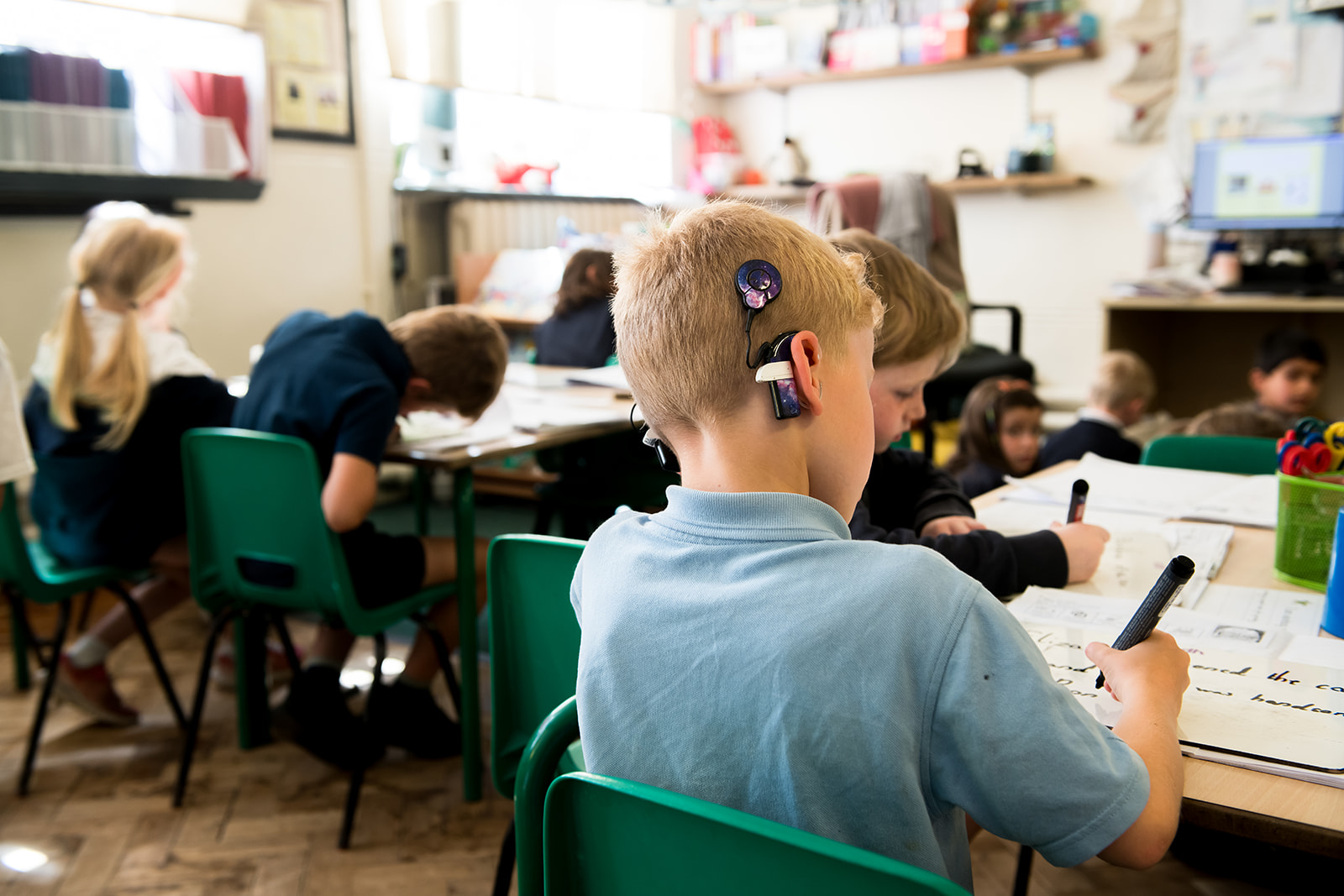
If the child has a cochlear implant the radio aid receiver either slots into the bottom of the processor, or attaches between the processor and battery.

The initial set up of the radio aid for the child is carried out by the Educational Audiologist from the Sheffield Service for Deaf Children.  To ensure the set up level is consistently meeting the child’s needs, speech discrimination tests are periodically carried out by the teachers of the deaf in school.